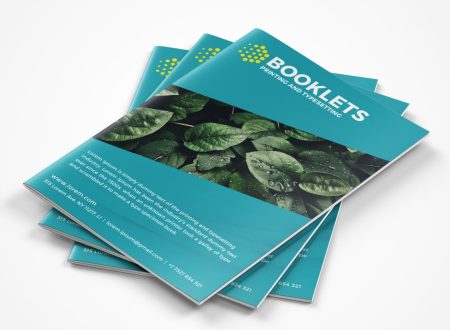
A single-sheet flyer works fine when you’re selling one product or one offer. It falls apart the moment you’re trying to represent forty, eighty, or two hundred products at once. Businesses with long catalogs — distributors, manufacturers, wholesalers, multi-line retailers — often try to force their full product range onto a flyer or a website page alone, and lose sales to the friction that creates. A well-built booklet solves a problem that flyers and single web pages structurally can’t.
The Limits of a Single-Sheet Flyer for Large Product Lines
A flyer has room for one message and a handful of products before it becomes cluttered and unreadable. Businesses with large catalogs who try to compress everything onto a flyer end up with tiny type, cramped layouts, and a piece that customers skim past instead of read. The alternative — sending customers to a website to browse everything — works for some buyers, but not all of them, and it removes the physical, browsable reference that many B2B and repeat customers actually prefer to keep on hand.
A booklet gives a large catalog the space it needs: enough pages to organize products into logical categories, enough room for real photography and specs, and a format customers can flip through at their own pace instead of scrolling.
How a Well-Organized Booklet Reduces Sales-Cycle Friction
For B2B buyers and repeat wholesale customers especially, a browsable printed catalog often shortens the sales cycle rather than lengthening it. A buyer flipping through a well-organized booklet can compare options side by side, mark pages, and reference the same physical document across multiple conversations — something that’s harder to do consistently across a website session that resets every visit.
The organization matters as much as the printing. Grouping products by category, use case, or price tier — rather than an arbitrary list — turns a booklet from a reference document into a sales tool that guides the buyer toward a decision instead of just presenting options.
Binding Options and When to Use Each
The binding method affects both cost and how the booklet holds up to repeat use:
- Saddle stitch (stapled at the spine) is the most economical option and works well for shorter catalogs, typically under 60 pages. It’s fast to produce and cost-effective for smaller print runs.
- Perfect bound (glued, flat spine like a paperback) is built for thicker catalogs — generally 60 pages and up — and gives a more durable, premium feel that holds up better to repeated handling over a longer shelf life.
Choosing saddle stitch for a catalog that’s really a perfect-bound-length document usually results in a booklet that doesn’t lie flat and wears out faster than expected. Matching the binding to the actual page count avoids that mismatch.
Paper and Finish Choices That Affect Perceived Value
Paper stock and finish shape how a catalog is perceived before a buyer reads a single product description. Heavier stock feels more substantial and signals a more established business; a coated, satin, or gloss finish makes product photography pop in a way uncoated paper can’t. For catalogs meant to represent a premium product line, these choices matter as much as the content itself — a catalog printed on thin, uncoated stock can undercut even well-designed content.
Conclusion
A flyer can announce a product. A website can list one. Neither can do what a well-organized, professionally printed booklet does for a business with a genuinely large catalog: give buyers a browsable, comparison-friendly reference that shortens the path from interest to order. Idea Makers designs and prints custom catalog booklets in-house in Miami, in saddle stitch and perfect bound formats sized to your product line. Call (305) 615-3320 or start your catalog project to give your full product line the presentation it deserves.